
gemini-3
Gemini 3 thinking_level Explained: Speed, Cost, and Quality Trade-offs
Gemini3 Team · August 7, 2026 · 6 min read
Keywords: gemini 3 thinking level, gemini api cost, midassai chat
Published: August 7, 2026 Author: Gemini3 Team
Understanding the Thinking Level Parameter
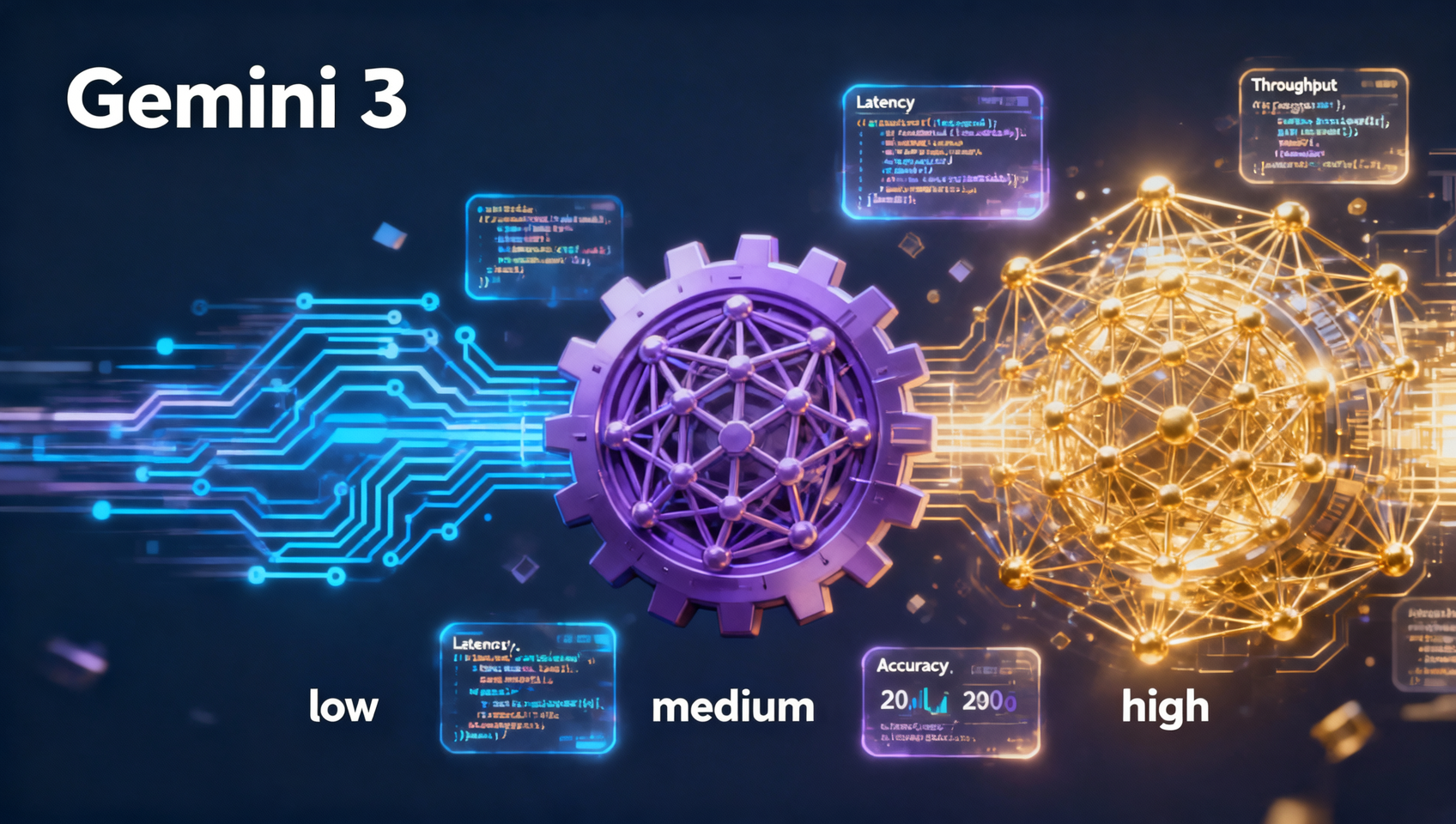
When integrating generative AI into production workflows, the default settings rarely align with specific business constraints. Gemini 3 introduces a critical configuration parameter: thinking_level. This setting allows developers and product managers to dictate how much computational effort the model expends on reasoning before generating a response. It is not merely a quality slider; it is a direct lever for controlling latency and token consumption.
Many teams make the mistake of leaving this parameter at the default, often MEDIUM, regardless of the task. This leads to unnecessary costs for simple queries or insufficient reasoning for complex logical problems. Understanding the trade-offs between LOW, MEDIUM, and HIGH is essential for optimizing both the user experience and the operational budget. This guide maps these levels to concrete use cases and demonstrates how to implement them effectively.
Who This Is For
This analysis is designed for technical leads, backend developers, and product owners who are deploying Gemini 3 models via API or interface. If you are building customer support bots, data extraction pipelines, or creative assistants, you need to know when to prioritize speed over depth. It is also relevant for non-technical users who want to understand why certain queries take longer to process on platforms like MidassAI Chat. If you are managing API costs or trying to reduce response latency for end-users, adjusting the thinking level is your first optimization step.
Breaking Down LOW, MEDIUM, and HIGH
The thinking_level parameter fundamentally changes the model's internal processing chain. It determines how many reasoning steps the model takes before committing to an output token.
LOW: Speed and Efficiency
Setting thinking_level to LOW instructs the model to prioritize immediate token generation. The model skips extended chain-of-thought processes and relies on pattern matching and direct retrieval. This is ideal for high-throughput scenarios where latency is the primary KPI.
- Best Use Cases: Simple classification, sentiment analysis, basic entity extraction, or greeting responses.
- Pitfall: Using
LOWfor math or logic puzzles often results in hallucinations or incorrect reasoning because the model does not "pause" to verify its steps. - Cost Impact: Lowest token consumption and fastest time-to-first-token.
MEDIUM: The Balanced Default
MEDIUM is the standard configuration for general-purpose assistants. It allows the model to engage in moderate reasoning without significant delay. It strikes a balance between being conversational and being accurate.
- Best Use Cases: General customer support, summarization of medium-length documents, and code completion for standard functions.
- Pitfall: It may still struggle with multi-step logical constraints or highly specialized domain knowledge that requires deep deduction.
- Cost Impact: Moderate. You pay for the extra reasoning tokens, but latency remains acceptable for interactive chat.
HIGH: Deep Reasoning and Accuracy
When set to HIGH, the model engages in extensive internal monologue and verification steps. It breaks down complex problems into sub-tasks before answering. This is necessary for tasks where accuracy is non-negotiable.
- Best Use Cases: Complex coding architecture, legal contract analysis, mathematical problem solving, and strategic planning.
- Pitfall: Latency increases significantly. Users might perceive the system as "hung" if the interface does not indicate processing status.
- Cost Impact: Highest. The internal reasoning tokens count towards your usage, increasing the cost per query.
{"headers":["Feature","Benefit"],["rows":[["Speed","Faster creation"],["Quality","Studio-grade output"]]}Implementation via API
Implementing these levels requires explicit parameter passing in your API request body. Below is a representative snippet showing how to configure the thinking level in a standard POST request.
POST /v1/models/gemini-3:generate
{
  "prompt": "Analyze this dataset for anomalies.",
  "thinking_level": "HIGH",
  "temperature": 0.2
}
When setting thinking_level to HIGH, you should also consider lowering the temperature. High reasoning combined with high randomness can lead to inconsistent logical paths. Conversely, for LOW thinking levels in creative tasks, you might increase temperature to encourage variety, as the reasoning overhead is minimal.
Developers should implement retry logic specifically for HIGH thinking levels. Because these requests take longer, they are more susceptible to gateway timeouts. Setting appropriate timeout thresholds in your HTTP client is critical to prevent premature connection drops.
The MidassAI Chat Advantage
While API integration offers granular control, it requires development overhead to manage keys, handle rate limits, and build interfaces for testing different parameters. This is where MidassAI Chat provides immediate value. You can test different thinking levels without writing a single line of code.
On MidassAI Chat, the interface abstracts the complexity while giving you the power of Gemini 3. You can switch between modes to see how the same prompt performs under different constraints. This is particularly useful for prompt engineering. You might find that a well-structured prompt at MEDIUM thinking level outperforms a vague prompt at HIGH. Iterating on prompts in the chat interface allows you to find the sweet spot before committing to an API implementation.
Furthermore, MidassAI Chat handles the infrastructure scaling. If you run a batch job with HIGH thinking levels, the platform manages the concurrency limits. For teams validating workflows, starting in the chat interface reduces the time-to-insight significantly. You can verify the output quality before investing in backend integration.
Quick Takeaways
Making the Choice
Selecting the right thinking level is not a one-time decision; it should be dynamic based on the user intent. For example, a customer support bot could default to LOW for initial greetings and triage. If the user indicates frustration or asks a complex technical question, the system can escalate the context to a HIGH thinking level process for the next turn.
This dynamic approach optimizes costs without sacrificing user experience. You avoid paying for deep reasoning on simple "Hello" messages while ensuring complex issues get the attention they require. Monitoring your usage logs is essential. If you see high latency complaints, check if too many requests are pinned to HIGH. If you see accuracy drops in logic tasks, verify they aren't stuck on LOW.
Optimization is an iterative process. Start with MEDIUM as your baseline. Measure the success rate of your completions. If tasks are failing due to lack of reasoning, shift to HIGH. If tasks are succeeding but latency is too high, attempt to refine the prompt to work with LOW or MEDIUM.
To see these trade-offs in action without setting up an environment, you should try running your own workflows on MidassAI Chat. It provides the sandbox needed to validate your assumptions about speed and quality before deployment.
Final Thoughts
The thinking_level parameter is one of the most powerful tools in the Gemini 3 toolkit. It puts the control of cost and performance directly in your hands. By matching the setting to the task complexity, you build more efficient and reliable AI applications. Whether you are coding via API or prototyping in a chat interface, understanding these levels ensures you get the most value from the model.
Ready to optimize your AI workflows? Try Gemini 3 on MidassAI Chat to experiment with different thinking levels today.